Most of the air in your home passes through one small rectangle several times a day, and hardly anyone measures that rectangle correctly. The faded numbers stamped on an old 10x18x2 air filter make a tempting shortcut. Skip the tape, trust the print, and order whatever the frame says. We understand the appeal. After measuring thousands of return openings, we can tell you how that shortcut usually ends. You get a filter that rattles in the cabinet, leaks air around its edges, or jams into a slot it was never built for. The better move takes about five minutes. The rule behind it is simple. Measure the slot itself, not the worn filter. Get that right, and the 10x18x2 you order will seal tight, move air the way your system expects, and catch what you actually bought it to catch.
TL;DR Quick Answers
10x18x2 Air Filters
A 10x18x2 air filter is a 2-inch-deep pleated filter for a slot measuring about 10 by 18 inches. It's an odd, non-stock size, so measure the opening itself, round down to the nearest 1/8 inch, and order it from a specialty source for a tight, sealing fit.
• Actual vs. nominal: the real filter runs close to 9 1/2 by 17 1/2 by 1 3/4 inches, while the printed 10x18x2 is the nominal size.
• Depth is set by your equipment: the "2" is the slot depth, so a true 2-inch filter is required, and a 1-inch filter leaves a gap for air to bypass the media.
• Measure the slot, not the old filter: worn frames show faded, rounded numbers you can't trust.
• Best for allergies: reach for MERV 11 to 13 if your system can pull air through it without strain.
• Where to find it: big-box shelves rarely stock this size, so specialty or made-to-order sources ship the exact dimensions to your door.
Top Takeaways
• Measure the slot opening, not the printed size on a worn-out filter.
• Write down length, width, and depth, then round down to the nearest 1/8 inch.
• The 2 in 10x18x2 is the depth, and your equipment fixes it, so use a true 2 inch filter.
• The real filter runs a touch smaller than its nominal size. A small, even gap is fine. A loose fit is not.
• Plan to order 10x18x2 from a specialty or made-to-order source, since big-box shelves rarely carry it.
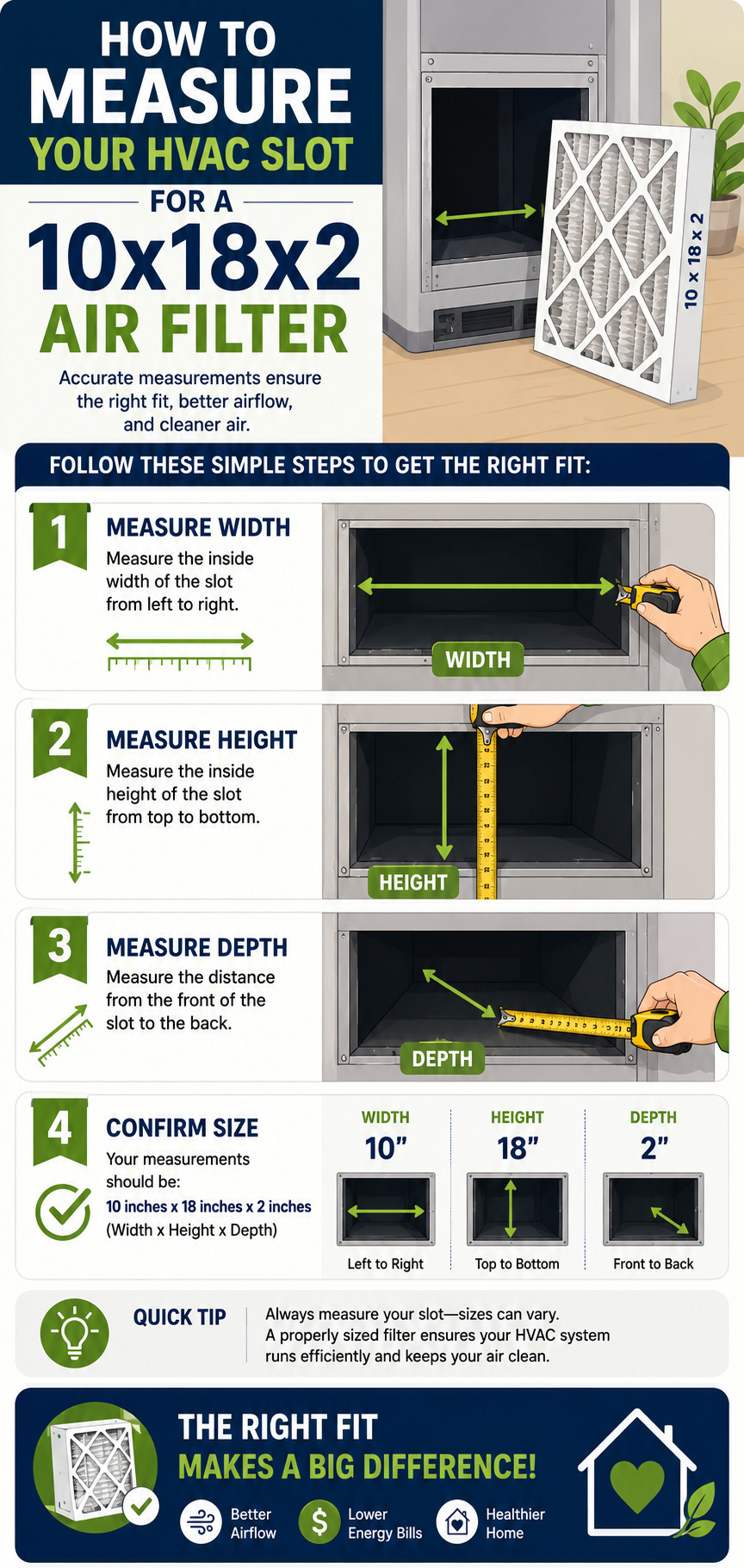
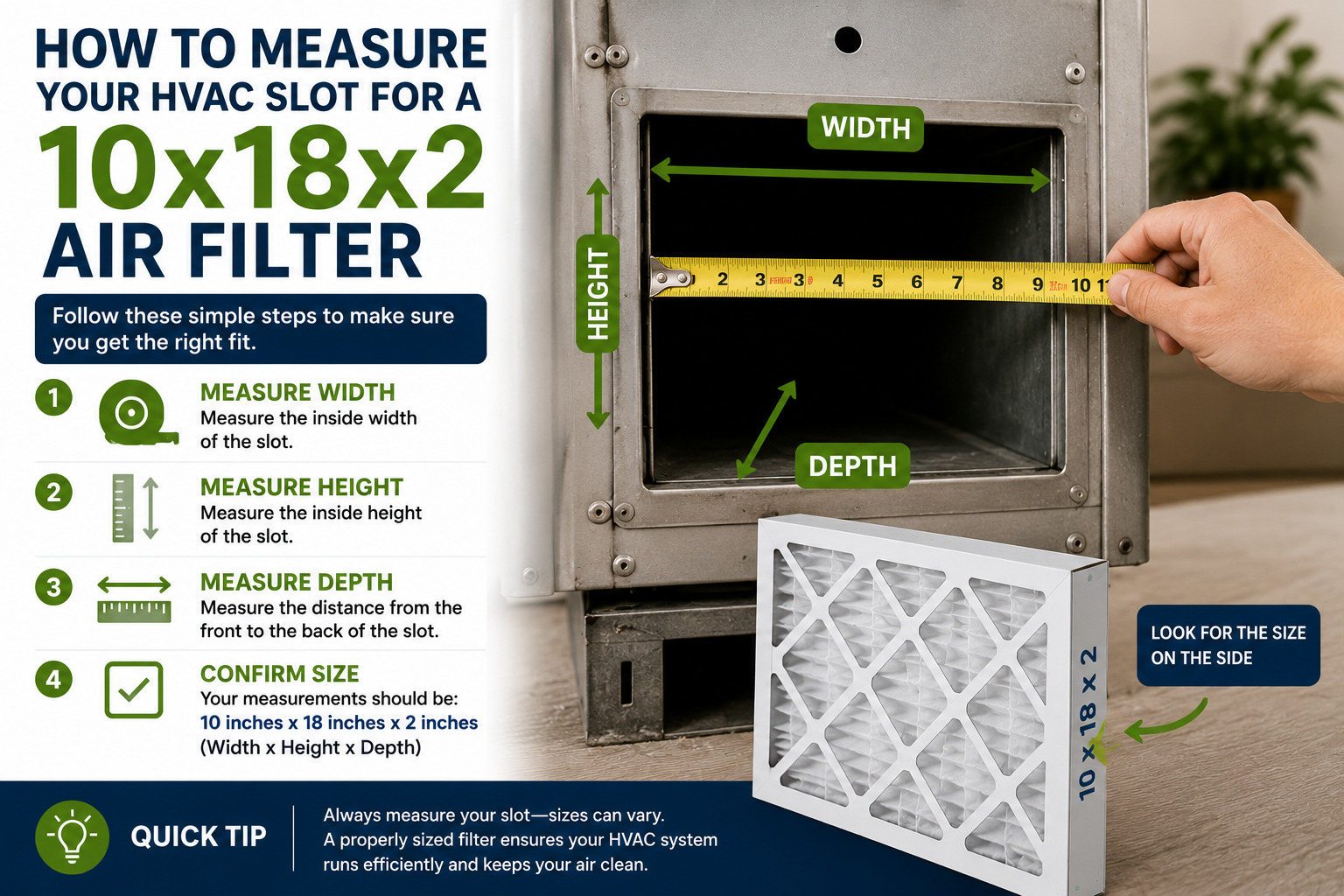
Measuring Your Slot for a 10x18x2 Air Filter, Step by Step
Switch the system off at the thermostat first. You don’t want the blower pulling dust into an open cabinet while you work. Now slide the old filter out and set it aside, because you’re about to measure the opening instead of the filter. That distinction matters more than it sounds. The size printed on a used filter is a nominal number, and after a year in a warm return it is often rounded, smudged, or simply wrong for what the housing actually needs.
Grab a steel tape and measure the inside of the slot three ways:
• Length and width: measure the inside edges, corner to corner, to the nearest 1/8 inch.
• Depth: measure front to back. On a 2 inch filter, that opening lands very close to two inches.
• Round down: when a measurement falls between marks, round down to the nearest 1/8 inch so the filter slides in clean.
Here is where most people get tripped up, and it pays to know before you order. Filter makers build the product a hair smaller than the number on the label, so it drops into the housing without crushing the pleats. A nominal 10x18x2 filter usually measures right around 9 1/2 by 17 1/2 by 1 3/4 inches in real life. That small, even gap is normal. A filter that slides around loose or shows daylight along one edge is not, because air takes the easy path and skips the media. Unfiltered air sneaking around the frame is the exact problem you set out to solve.
Depth carries as much weight as length and width, and people forget it constantly. The 2 in 10x18x2 is the depth, and your equipment fixes it, not your preference. A 2 inch slot wants a 2 inch filter. Drop a 1-inch filter into it and you leave a full inch for air to slip around the frame. Stack two thin filters to fill the space and you choke airflow badly enough to strain the blower. When your slot measures two inches deep, a true 2-inch pleated filter is the right answer, and it rewards you with more media surface and a longer stretch between changes than a 1 inch ever could.
Now, the part that frustrates people. A 10x18x2 rarely sits on a shelf at the hardware store, so the usual grab-and-go trip comes up empty. Specialty and made-to-order sources keep it stocked, and you can explore pleated 10x18x2 air filter options without settling for a near miss that fits poorly. When you order, match the nominal size you measured and double-check the actual dimensions in the product details before you buy.
One more point, since it is the question we field most. In our own testing, our MERV 8, 11, and 13 pleated media caught roughly 90, 95, and 98 percent of the particles we ran at them, which is why we steer most homes with pets or allergies toward the higher ratings. Want the background on how a pleated media filter actually traps particles? It helps to see why surface area and a tight seal matter as much as the rating printed on the box.
“The biggest sizing mistake I see is folks trusting the faded print on a filter that has spent a year baking in a humid return, when the number worth trusting is the slot itself. Measure the opening, write the three dimensions on painter’s tape inside the cabinet door, and an odd size like 10x18x2 stops being a guessing game.”
7 Essential Resources Worth Bookmarking Before You Buy
We lean on primary sources, not filter-store blogs. Each one below is current, and each earns the few minutes it takes to read.
• Air Filter Basics, Explained: a plain-language rundown of how filter media grabs particles and why build quality changes the result.
• EPA Guide to Air Cleaners in the Home: federal guidance on picking a furnace or HVAC filter and matching it to the system you have.
• DOE Air Conditioner Maintenance: the Department of Energy on why a clean, well-fitted filter protects efficiency.
• ENERGY STAR Heat and Cool Efficiently: a simple rhythm for checking and changing your filter before it costs you.
• CDC Guidance on Ventilation and Filter Fit: public-health advice on filtration, including the step most people skip, which is sealing the filter in the rack.
• Ohio State University Extension on Home HVAC: university guidance on how forced-air systems use a filter and where sizing fits in.
• AirNow Air Quality Index Basics: check outdoor air so you know when pollen and wildfire season call for a faster change schedule.
3 Statistics That Make the Case for the Right Fit
• Up to 15 percent. The U.S. Department of Energy notes that swapping a dirty, clogged filter for a clean one can cut an air conditioner’s energy use by 5 to 15 percent.
• About 90 percent. The EPA reports that Americans spend roughly 90 percent of their time indoors, where some pollutants run two to five times higher than outside.
• Around 25 million. The CDC counts about 25 million children and adults in the U.S. living with asthma, the households where a tight-sealing filter earns its keep fastest.
Our Take: Measure Once, Buy With Confidence
If we could hand you a single habit, it is this. Measure the slot before you trust any number on an old frame. With a common size, a guess sometimes survives. With a 10x18x2 air filter, it usually does not, and a poor fit quietly cancels out everything a good filter is supposed to do for you. Here is our honest position after years of answering sizing questions. The right fit beats a higher rating every time. A well-sealed MERV 8 will outwork a MERV 13 that leaves gaps along the edge, no contest. If allergies drive your decision, we lean toward a 10x18x2 allergen air filter in the MERV 11 to 13 range, as long as your system can pull air through it without strain. Size first. Rating second. Get those in order and you have done the hard part.
Frequently Asked Questions
Is a 10x18 air filter the same as a 10x18x2?
Not quite. A 10x18 listing only gives you length and width. The third number, the depth, still decides whether the filter seals. A 10x18x2 runs two inches deep, and a 1 inch filter will not seal right in that slot.
Can I put a 1 inch filter in a 2 inch slot?
No. That extra inch hands air a path around the media, and stacking two 1 inch filters to fill the gap chokes airflow and strains the blower. Match the depth your housing was built for.
What is the best 10x18x2 air filter for allergies?
For allergies, reach for a MERV 11 to 13 pleated filter, which captures more pollen, dust, and pet dander. Confirm your system handles the higher rating, then pick the highest one your blower and slot allow.
How often should I replace a 10x18x2 pleated air filter?
A 2 inch pleated filter generally goes about three months. Pets, allergies, heavy runtime, and wildfire or pollen season shorten that, so eyeball it monthly and change it once it looks loaded.
Where can I find a 10x18x2 air filter near me?
Local shelves rarely stock an odd size like this. A specialty or made-to-order supplier ships the exact size to your door, which usually beats driving store to store.
My measurements aren’t landing on a round number. What size do I order?
Round the slot measurement down to the nearest 1/8 inch, then match it to the nominal size. If nothing standard fits, a made-to-order filter cut to your exact dimensions will seal best.
Get the Right Fit the First Time
Measure your slot, jot down all three dimensions, and order the exact 10x18x2 size your system was built around. We make a precise, well-sealing fit easy to get and ship it straight to your door, so your air stays cleaner and your system breathes the way it should.
Learn more about HVAC Care from one of our HVAC solutions branches…
Filterbuy HVAC Solutions - Weston FL
2573 Mayfair Lane Weston FL 33327
(754) 296-3528
https://maps.app.goo.gl/E3tjmKf5VSWYghGc7